Showing posts with label Embedded System. Show all posts

Saturday, September 25, 2010

Interfacing PIC Microcontrollers: Embedded Design by Interactive Simulation

Martin Bates, "Interfacing PIC Microcontrollers: Embedded Design by Interactive Simulation" 
Newnes | 2006 | ISBN: 0750680288 | 312 pages | File type: PDF | 3 mb

Explore in detail microcontroller interfacing techniques using the popular PIC 16F877 Work through step-by-step examples interactively using circuit simulation software, supplied as assembly source code
Gain the knowledge of a wide range of peripheral devices such as keyboards, displays, sensors and drives and serial communication with other processors, memory and more Use interactive simulation software to design and test circuits

Interfacing PIC Microcontrollers provides a thorough introduction to interfacing techniques for students, hobbyists and engineers looking to take their knowledge of PIC application development to the next level. Each chapter ends with suggestions for further applications, based on the examples given, and numerous line drawings illustrate application of the hardware.

Step-by-step examples in assembly language are used to illustrate a comprehensive set of interfaces, and these can be run interactively on circuit simulation software, used to aid understanding without the need to build real hardware.

A companion website includes all examples in the text which can be Download:
ed together with a free version of Proteuss ISIS Lite: www.picmicros.org.uk

*Comprehensive coverage of a topic not widely explored in the wealth of PIC books on the market, concentrating on the popular PIC16F877 device
*Circuit simulation software allows step-by-step examples, supplied as assembly source code, to be run interactively aiding student, technician and hobbyist learning.
*A companion website includes all examples in the text which can be Download:
ed together with a free version of Proteuss 

Download:

uploading.com

 
depositfiles.com

 
www.filesonic.com


Microcontroller Projects in C for the 8051

Dogan Ibrahim, "microcontroller projects in C for the 8051" 
Newnes | 2000 | ISBN: 0750646403 | 178 pages | File type: PDF | 1,3 mb


This book is a thoroughly practical way to explore the 8051 and discover C programming through project work. Through graded projects, Dogan Ibrahim introduces the reader to the fundamentals of microelectronics, the 8051 family, programming in C, and the use of a C compiler. The specific device used for examples is the AT89C2051 - a small, economical chip with re-writable memory, readily available from the major component suppliers.

A working knowledge of microcontrollers, and how to program them, is essential for all students of electronics. In this rapidly expanding field many students and professionals at all levels need to get up to speed with practical microcontroller applications. Their rapid fall in price has made microcontrollers the most exciting and accessible new development in electronics for years - rendering them equally popular with engineers, electronics hobbyists and teachers looking for a fresh range of projects. 
Microcontroller Projects in C for the 8051 is an ideal resource for self-study as well as providing an interesting, enjoyable and easily mastered alternative to more theoretical textbooks.

Dogan Ibrahim has been Associate Professor and Head of Department at the Near East University, Cyprus, lecturer at South Bank University, London, Principal Research Engineer at GEC Hirst Research center, and is now a hardware and software systems consultant to London's Traffic Control Systems Unit.

Practical projects that enable students and practitioners to get up and running straight away with 8051 microcontrollers
A hands-on introduction to practical C programming
A wealth of project ideas for students and enthusiasts 

Download:

uploading.com

 
depositfiles.com

www.filesonic.com


Friday, September 24, 2010

Technician's Guide to the 68HC11 Microcontroller

Dan Black, "Technician's Guide to the 68HC11 Microcontroller"
Delmar Cengage Learning |2000 | ISBN: 0766817156 | 381 pages | File type: PDF | 3 mb


Technician's Guide to the 68HC11 Microcontroller is ideal for readers with little or no prior programming experience who want to master the basics of troubleshooting and programming Motorola's 68HC11 microcontroller. Both hardware and software are covered in detail to provide a complete understanding of the principles underlying how a microcontroller works. Theory is supplemented by examples designed to illustrate how concepts may be applied. By learning how to program the 68HC11 at an elementary level, readers also gain valuable experience using manufacturer-specific documentation that prepares them for work with other more sophisticated microcontrollers.

Download:

uploading.com

depositfiles.com

filesonic.com


Friday, September 17, 2010

LCD Interfacing using CCS C, Parallel


Monday, September 6, 2010

Programming Embedded Systems in C and C


Programming Embedded Systems in C and C By Michael Barr
Publisher: O'Reilly Media 1999 | 200 Pages | ISBN: 1565923545 | File type: PDF | 1 mb

Embedded software is in almost every electronic device designed today. Yet because each embedded system is unique and highly customized to its application, it can be a difficult field to master. However, if you have some programming experience and are familiar with C or C , you're ready to learn how to write embedded software. The hands-on, no-nonsense style of this book will help you get started by offering practical advice from someone who's been in your shoes and wants to help you learn quickly. The techniques and code examples presented here are directly applicable to real-world embedded software projects of all sorts. Even if you've done some embedded programming before, you'll still benefit from this book. Topics include: testing memory chips, writing and erasing Flash memory, verifying nonvolatile memory contents, interfacing to on-chip and external peripherals, device driver design and implementation, optimizing embedded software for size and speed, and making the most of C without a performance penalty.


 Download links :

http://depositfiles.com/files/01g0xh9mf

http://www.filesonic.com/file/18682999/Programming embedded systems in C and C .rar


Monday, June 7, 2010

Model-Based Design for Embedded Systems


                                                        *In this book is organized into three sections: Real-Time and Performance Analysis in Heterogeneous Embedded Systems, Design Tools and Methodology for Multiprocessor System-on-Chip, and Design Tools and Methodology for Multidomain Embedded Systems. The respective contributors share their considerable expertise on the automation of design refinement and how to relate properties throughout this refinement while enabling analytic and synthetic qualities. They focus on multi-core methodological issues, real-time analysis, and modeling and validation, taking into account how optical, electronic, and mechanical components often interface.


                                                        The model-Based Design is emerging as a solution to bridge the gap between the availability of computational capabilities and our inability to make full use of them yet. This approach enables teams to start the design process using a high-level model that is gradually refined through abstraction levels to ultimately yield a prototype. When executed well, Model-Based Design encourages enhanced performance and quicker time to market for a product. Illustrating a broad and diverse spectrum of applications such as in the automotive aerospace, health care, consumer electronics, this volume provides designers with practical, readily adaptable modeling solutions for their own practice.


http://www.megaupload.com/?d=WS6CI67Y 


http://uploading.com/files/7mm3994d/1420067842_DesignEmbedded.rar/  


Embedded Systems Design, May 2010


                                                   *The embedded Systems Design is a monthly magazine for engineers, programmers, and project leaders who build microcontroller and embedded microprocessor-based systems. The magazine's in-depth, technical articles are written by experts in the field and focus on practical ways for engineers to improve their hardware/software integration skills, software design, and optimization.


http://ugotfile.com/file/1370409/Embedded system design.rar


http://hotfile.com/dl/43272779/d167204/Embedded_system_design.rar.html


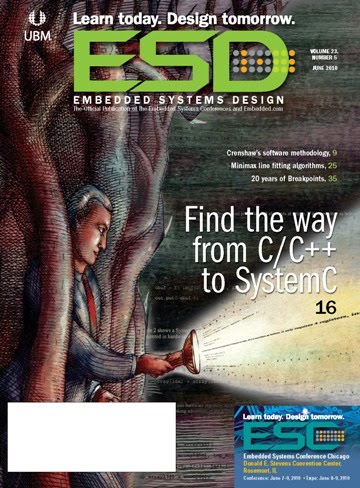
Embedded Systems Design - June 2010


                                               *The embedded Systems Design is a monthly magazine for engineers, programmers, and project leaders who build microcontroller and embedded microprocessor-based systems. The magazine's in-depth, technical articles are written by experts in the field and focus on practical ways for engineers to improve their hardware/software integration skills, software design, and optimization.


 http://freakshare.net/files/c3fblnk7/esd0610.pdf.html


 http://hotfile.com/dl/45838421/f67ff27/esd0610.pdf.html 


Embedded Linux


                                      The embedded systems are now all we encounter in everyday life: the microcontroller in the washing machine to powerful DSP on the car radio. A few years ago, these complex processors programmed in assembly language and had, in most cases, an operating system. Meanwhile, a slim but powerful Linux derivatives on simple processors offer the comfort of the driver interface, the multi-threading and a file system. The presented hardware is partly borrowed from consumer products and thus easily available.


http://hotfile.com/dl/38551752/db46d9f/Embedded20Linux.20Das20Praxisbuch.rar.html


Embedded Systems Handbook, Second Edition- Networked Embedded Systems


                                             *In this second self-contained volume of the handbook and Network Embedded Systems, focuses on select application areas. It covers the automotive field, industrial automation, building automation, and wireless sensor networks. This volume highlights implementations in fast-evolving areas which have not received proper coverage in other publications. Reflecting the unique functional requirements of different application areas, the contributors discuss inter node communication aspects in the context of specific applications of networked embedded systems.

http://www.megaupload.com/?d=CMV8C1BG Megaupload


Sunday, June 6, 2010

Analog Interfacing to Embedded Microprocessor Systems, 2nd Edition


Description

                                           It provides hard-to-find information on interfacing analog devices and technologies to the purely digital world of embedded microprocessors. Gives the reader the insight and perspective of a real embedded systems design engineer, including tips that only a hands-on professional would know. It covers important considerations for both hardware and software systmes when linking analog and digital devices. -Embedded Technology a comprehensive source on interfacing the real world to microprocessors should prove invaluable to embedded systems engineers, students, technicians, and hobbyists. Anyone involved in connecting the analog environment to their digital machines, or troubleshooting such connections will find this book especially useful. - Embedded Technology In general, for all the sections, there are plenty of simple diagrams and also the maths is kept to a simple level. I like this book and recommend it as an introduction to the subject for home use, students and SW Engineers. - Chris Hills in the ACCU magazine CVu, there plenty of simple diagrams and also the maths is kept to a simple level. I like this book and recommend it as an introduction to the subject for home use, students and engineers. -Chris Hills in the ACCU magazine CVu


http://www.megaupload.com/?d=KI04H7OY

http://uploading.com/files/82e76a56/0750677236AnaloSystems.rar/


Saturday, June 5, 2010

Embedded Microprocessor Systems - Real World Design


This book will provide an excellent introduction for someone new to the art of embedding microprocessors into systems. It is labeled as an introduction to the design of embedded microprocessor systems, and I think it achieves this better than any other book I have seen. So can I recommend this book? Yes, very much. It is up-to-date, clear, and full of helpful tips.
-Dr. Alistair Armitage, 

 http://www.4shared.com/document/IN8j8RT6/BALL_S_R__2002__Embedded_Micro.html


Friday, June 4, 2010

Embedded Controller Hardware Design.pdf


Description

The book gives great introduction to low-end, controller design.

Embedded Controller Hardware Design targets one of the most popular embedded controllers around, the 8051. The book, written by Ken Arnold for LLH Technology Publishing, is a great introduction to low-end, controller design, especially for developers fresh out of college or just off other projects that are used to 32-bit systems running Windows and Linux. Experienced 8-bit embedded designers will not find the book as useful unless they're unfamiliar with the 8051 and need to use it in a new project. The coverage ranges from a novice level introduction of electronics that touches on resistors and tristate buffers to more advanced topics like bus current limitations and using 8-bit microcontrollers and PLDs (programmable logic devices). The bulk of the book concentrates on important detail like bus loading, timing, and the use of I/O, DMA, and interrupts. The software aspects represent a key part of the book but they're not in the majority, so grab an 8051 programming book for software design. Still, there's enough software to touch on the aspects that will affect hardware designs, such as interrupt routine timing and synchronization. The 8051 architecture is discussed in detail. It's suitable for consumption by novices and handy as a quick reference as well. Examples are sprinkled throughout. The book is designed to be used with 8031SDK, which is available online. A CD-ROM, included with the book, offers an eBook version of the text and software samples.


Wednesday, June 2, 2010

Programming Microcontrollers in C, Second Edition (Embedded Technology Series)


Review

"Van Sickle's book will quickly pay for itself. . ."
--Dr. Dobb's Journal

"The book covers the essentials of C, programming actual microcontrollers, and discusses real world examples as well as theoretical models."
--Embedded Systems Programming Product News

"A must-read for engineers trying to get a handle on software issues . . . I get a constant stream of queries for introductory texts to the embedded-systems world. This is the book. It should be required reading even in computer curriculum, where embedded systems get virtually no mention."
--EDN


http://www.4shared.com/file/70579936/945443c/VAN_SICKLE_T__2001__Programming_Microcontrollers_in_C__2nd_ed_.html 


Sunday, May 16, 2010

PICmicro MCU C: An introduction to Programming the Microchip PIC in CCS C by Nigel Gardner


Product Description

This 2nd edition book is a complete introduction to programming Microchip PICmicros in C with the use of the CCS C compiler. The book overviews the ease of using C and the CCS compiler for optimization of your programming. There are many examples to get you started on while using the compiler.

Download


Saturday, May 15, 2010

The Definitive Guide to the ARM Cortex M3 TI Second Edition by Joseph Yiu


Product Description

This user's guide does far more than simply outline the ARM Cortex-M3 CPU features; it explains step-by-step how to program and implement the processor in real-world designs. It teaches readers how to utilize the complete and thumb instruction sets in order to obtain the best functionality, efficiency, and reuseability. The author, an ARM engineer who helped develop the core, provides many examples and diagrams that aid understanding. Quick reference appendices make locating specific details a snap!


For Free Downloads.


Whole chapters are dedicated to:
Debugging using the new CoreSight technology
Migrating effectively from the ARM7
The Memory Protection Unit
Interfaces, Exceptions,Interrupts
...and much more!

  • The only available guide to programming and using the groundbreaking ARM Cortex-M3 processor
  • Easy-to-understand examples, diagrams, quick reference appendices, full instruction and Thumb-2 instruction sets are included 
  • T teaches end users how to start from the ground up with the M3, and how to migrate from the ARM7


Co-verification of Hardware and Software for ARM SoC Design (Embedded Technology)


Review

"Jason Andrews is one of the acknowledged world's experts in hardware/software verification. His unique knowledge, spanning both hardware design and software development, has enabled him to come up with breakthrough design tools and methodologies solving many of today's most pressing verification challenges. This is one of the most important books to come on the scene in the last ten years." Gary Smith, Chief Analyst, Design & Engineering, Gartner Dataquest .
For Free Downloads.

Book Description

Faster time to market, increased confidence in designs, and higher productivity through shorter testing times can be achieved via co-verification- this book shows you how!

Product Description

Hardware/software co-verification is how to make sure that embedded system software works correctly with the hardware, and that the hardware has been properly designed to run the software successfully -before large sums are spent on prototypes or manufacturing.

This is the first book to apply this verification technique to the rapidly growing field of embedded systems-on-a-chip(SoC). As traditional embedded system design evolves into single-chip design, embedded engineers must be armed with the necessary information to make educated decisions about which tools and methodology to deploy. SoC verification requires a mix of expertise from the disciplines of microprocessor and computer architecture, logic design and simulation, and C and Assembly language embedded software. Until now, the relevant information on how it all fits together has not been available. Andrews, a recognized expert, provides in-depth information about how co-verification really works, how to be successful using it, and pitfalls to avoid. He illustrates these concepts using concrete examples with the ARM core - a technology that has the dominant market share in embedded system product design. The companion CD-ROM contains all source code used in the design examples, a searchable e-book version, and useful design tools.

* The only book on verification for systems-on-a-chip (SoC) on the market

* Will save engineers and their companies time and money by showing them how to speed up the testing process, while still avoiding costly mistakes

* Design examples use the ARM core, the dominant technology in SoC, and all the source code is included on the accompanying CD-Rom, so engineers can easily use it in their own designs

About the Author

Jason Andrews is currently working in the areas of hardware/software co-verification and testbench methodology for SoC design at Verisity. He has implemented multiple commercial co-verification tools as well as many custom co-verification solutions. His experience in the EDA and embedded marketplace includes software development and product management at Verisity, Axis Systems, Simpod, Summit Design, and Simulation Technologies. He has presented technical papers and tutorials at the Embedded Systems Conference, Communication Design Conference and IP/SoC and written numerous articles related to HW/SW co-verification and design verification. He has a B.S. in electrical engineering from The Citadel, Charleston, S.C., and an M.S. in electrical engineering from the University of Minnesota. He currently lives in the Minneapolis area with his wife, Deborah, and their four children.


Download From 4shared


ARM System Developer's Guide: Designing and Optimizing System Software (The Morgan Kaufmann Series in Computer Architecture and Design)


Review

"The ARM architecture has enabled a rich set of new applications on increasingly powerful wireless platforms. Media-rich applications such as 3D games, camera and videophones, location-based services and connected portable music and video devices are enabled by next generation CDMA phones executing on the ARM architecture.
For Free donloads.


Developing embedded software for these platforms requires a knowledge of the underlying architecture, and programming practices which balance power, cost and performance efficient. Sloss provides a comprehensive and practical guide to the development of "hardware aware" software which meets the demanding constraints of these applications. Highlighted with practical examples, and enhanced by a thorough treatment of topics such as ISRs, code optimization, and DSP on ARM, this book is essential for every embedded software and hardware engineer alike."

-J. Scott Runner, Senior Staff Engineer/Manager, Qualcomm CMDA Technologies, Qualcomm Inc.

"This book has a place on the desk of every engineer developing software for the ARM processor; it is a thorough introduction for newcomers, and a useful reference for the ARM expert.

The technical information in this book is aimed squarely at the software developer, you'll find advice on bringing a device up from a bare board, reference information describing the characteristics of all current ARM architectures, and many valuable tips for optimizing code running on ARM cores.

I have been using this book since reviewing the first draft, and can recommend it to anyone who wants the get the best out of their ARM Powered products."

-Peter Maloy, CodeSprite Inc.

"This book provides an excellent introduction to the ARM architecture. It describes important architectural features in detail. It also makes great use of examples to illustrate those features and put them in context."

-Wayne Wolf, Princeton University

Book Description

A comprehensive guide to one of the most popular architectures in the embedded systems and SOC industry.

Product Description

Over the last ten years, the ARM architecture has become one of the most pervasive architectures in the world, with more than 2 billion ARM-based processors embedded in products ranging from cell phones to automotive braking systems. A world-wide community of ARM developers in semiconductor and product design companies includes software developers, system designers and hardware engineers. To date no book has directly addressed their need to develop the system and software for an ARM-based system. This text fills that gap.

This book provides a comprehensive description of the operation of the ARM core from a developer's perspective with a clear emphasis on software. It demonstrates not only how to write efficient ARM software in C and assembly but also how to optimize code. Example code throughout the book can be integrated into commercial products or used as templates to enable quick creation of productive software.

The book covers both the ARM and Thumb instruction sets, covers Intel's XScale Processors, outlines distinctions among the versions of the ARM architecture, demonstrates how to implement DSP algorithms, explains exception and interrupt handling, describes the cache technologies that surround the ARM cores as well as the most efficient memory management techniques. A final chapter looks forward to the future of the ARM architecture considering ARMv6, the latest change to the instruction set, which has been designed to improve the DSP and media processing capabilities of the architecture.

* No other book describes the ARM core from a system and software perspective.
* Author team combines extensive ARM software engineering experience with an in-depth knowledge of ARM developer needs.
* Practical, executable code is fully explained in the book and available on the publisher's Website.
* Includes a simple embedded operating system.

From the Back Cover

This book has a place on the desk of every engineer developing software for the ARM processor; it is a thorough introduction for newcomers, and a useful reference for the ARM expert. I have been using this book since reviewing the first draft, and I can recommend it to anyone who wants the get the most out of their ARM powered products.
- Peter Maloy, CodeSprite Inc.

Over the last ten years, the ARM architecture has become one of the most pervasive architectures in the world, with more than 2 billion ARM-based processors embedded in products ranging from cell phones to automotive braking systems. A world-wide community of ARM developers in semiconductor and product design companies includes software developers, system designers and hardware engineers. To date no book has directly addressed their need to develop the system and software for an ARM-based system. This text fills that gap.

This book provides a comprehensive description of the operation of the ARM core from a developer's perspective with a clear emphasis on software. It demonstrates not only how to write efficient ARM software in C and assembly but also how to optimize code. Example code throughout the book can be integrated into commercial products or used as templates to enable quick creation of productive software.

The book covers both the ARM and Thumb instruction sets, covers Intel's XScale
Processors, outlines distinctions among the versions of the ARM architecture, demonstrates how to implement DSP algorithms, explains exception and interrupt handling, describes the cache technologies that surround the ARM cores as well as the most efficient memory management techniques. A final chapter looks forward to the future of the ARM architecture considering ARMv6, the latest change to the instruction set, which has been designed to improve the DSP and media processing capabilities of the architecture.

Features

* No other book describes the ARM core from a system and software perspective.
* Author team combines extensive ARM software engineering experience with an in-depth knowledge of ARM developer needs.
* Practical, executable code is fully explained in the book and available on the publisher's Website.
* Includes a simple embedded operating system.

About the Author

By Andrew Sloss, Dominic Symes and Chris Wright

Excerpt. © Reprinted by permission. All rights reserved.

A comprehensive guide to one of the most popular architectures in the embedded systems and SOC industry.


Download From 4shared


MicroC OS II: The Real Time Kernel


Book Description

Micro C/OS-II, Second Edition is a completely portable, ROMable, preemptive real-time kernel. New edition includes new features of this latest version of the software, including real-time services, floating points, and coding conventions. 
 
 
For Free downloads.

Product Description

MicroC/OS II Second Edition describes the design and implementation of the MicroC/OS-II real-time operating system (RTOS). In addition to its value as a reference to the kernel, it is an extremely detailed and highly readable design study particularly useful to the embedded systems student. While documenting the design and implementation of the kernel, the book also walks the reader through the many related development issues: how to adapt the kernel for a new microprocessor, how to install the kernel, and how to structure the applications that run on the kernel. This edition features documentation for several important new features of the software, including new real-time services, floating points, and coding conventions. The accompanying CDROM includes complete code for the MicroC/OS-II kernel.

About the Author

Jean J. Labrosse is a senior technical staff member at Dynalco Controls in Fort Lauderdale, Fla. He has a master's degree in electrical engineering and has been designing embedded systems for many years. Labrosse is the author of the popular operating system and book MicroC/OS-II: The Real-Time Kernel. He has written articles for numerous magazines, and is a regular lecturer and advisory board member for the Embedded Systems Conference.


Download


Arm Architecture Reference Manual (2Nd Edition).pdf


Product Description

Produced by the architects that are actively working on the ARM specification, this book contains detailed information about all versions of the ARM and ThumbTM instruction sets, the memory management and cache functions, and optimized code examples. Both an architectural overview and programmer's model are presented. Coverage also includes 26-bit architectures and the System Control Coprocessor.
For Free Downloads.

From the Back Cover

About the ARM Architecture The ARM architecture is the industry's leading 16/32-bit embedded RISC processor solution. ARM Powered microprocessors are being routinely designed into a wider range of products than any other 32-bit processor. This wide applicability is made possible by the ARM architecture, resulting in optimal system solutions at the crossroads of high performance, low power consumption and low cost. About the book This is the authoritative reference guide to the ARM RISC architecture. Produced by the architects that are actively working on the ARM specification, the book contains detailed information about all versions of the ARM and Thumb instruction sets, the memory management and cache functions, as well as optimized code examples.

About the Author

David Seal is one of the chief instruction set architects working for ARM, and has worked with the ARM architecture since it was first developed in 1984-85. He received a BA in Mathematics from Cambridge University, England, and is the holder of several patents relating to the ARM architecture.


 Download From 4shared


Copyright Disclaimer:

This site does not store any copyright contents on its server. If any, email us, we'll remove relevant links or contents immediately. email: smsumesh89@gmail.com
Twitter Delicious Facebook Digg Favorites More