Showing posts with label PIC. Show all posts

Saturday, September 25, 2010

Interfacing PIC Microcontrollers: Embedded Design by Interactive Simulation

Martin Bates, "Interfacing PIC Microcontrollers: Embedded Design by Interactive Simulation" 
Newnes | 2006 | ISBN: 0750680288 | 312 pages | File type: PDF | 3 mb

Explore in detail microcontroller interfacing techniques using the popular PIC 16F877 Work through step-by-step examples interactively using circuit simulation software, supplied as assembly source code
Gain the knowledge of a wide range of peripheral devices such as keyboards, displays, sensors and drives and serial communication with other processors, memory and more Use interactive simulation software to design and test circuits

Interfacing PIC Microcontrollers provides a thorough introduction to interfacing techniques for students, hobbyists and engineers looking to take their knowledge of PIC application development to the next level. Each chapter ends with suggestions for further applications, based on the examples given, and numerous line drawings illustrate application of the hardware.

Step-by-step examples in assembly language are used to illustrate a comprehensive set of interfaces, and these can be run interactively on circuit simulation software, used to aid understanding without the need to build real hardware.

A companion website includes all examples in the text which can be Download:
ed together with a free version of Proteuss ISIS Lite: www.picmicros.org.uk

*Comprehensive coverage of a topic not widely explored in the wealth of PIC books on the market, concentrating on the popular PIC16F877 device
*Circuit simulation software allows step-by-step examples, supplied as assembly source code, to be run interactively aiding student, technician and hobbyist learning.
*A companion website includes all examples in the text which can be Download:
ed together with a free version of Proteuss 

Download:

uploading.com

 
depositfiles.com

 
www.filesonic.com


Friday, September 17, 2010

LCD Interfacing using CCS C, Parallel


Sunday, May 16, 2010

PICmicro MCU C: An introduction to Programming the Microchip PIC in CCS C by Nigel Gardner


Product Description

This 2nd edition book is a complete introduction to programming Microchip PICmicros in C with the use of the CCS C compiler. The book overviews the ease of using C and the CCS compiler for optimization of your programming. There are many examples to get you started on while using the compiler.

Download


Monday, May 10, 2010

Designing Embedded Hardware, 2005, John Catsoulis.pdf


Description
Embedded computer systems literally surround us: they're in our cell phones, PDAs, cars, TVs, refrigerators, heating systems, and more. In fact, embedded systems are one of the most rapidly growing segments of the computer industry today.
Along with the growing list


 Designing Embedded Hardware includes:
  • The theory and practice of embedded systems
  • Understanding schematics and data sheets
  • Powering an embedded system
  • Producing and debugging an embedded system
  • Processors such as the PIC, Atmel AVR, and Motorola 68000-series
  • Digital Signal Processing (DSP) architectures
  • Protocols (SPI and I2C) used to add peripherals
  • RS-232C, RS-422, infrared communication, and USB
  • CAN and Ethernet networking
  • Pulse Width Monitoring and motor control


EXPLORING C FOR MICROCONTROLLERS: A Hands on Approach.pdf

Product Description

The market is flooded with numbers of good books on Embedded Systems designed especially with the most popular MCS51 family. These books are traditional in nature i.e. they start with the routine architectural features of 8051, description of registers, ports, interrupts etc. Most of these things are already covered in the device data sheet and application notes. In this book all such routine things are skipped. The focus is on programming microcontrollers, to be specific MCS-51 family in ‘C’ using Keil IDE. Exploring C for Microcontrollers presents seventeen live case studies part from the many basic programs organized around every on-chip resource like port, time/counter, interrupt , serial I/O etc. Rather than introducing the underpinning theory or reproducing lengthy data sheets, our approach is "learning-through-doing" and one that appeals to busy electronics designers. The ‘C’ codes given are well supported by easy to understand comments wherever required. Mastering the basic modules and hands on working with the projects will enable to grasp the basic building blocks for most 8051 programs. Whether you are a student using the MCS-51 family of microcontrollers for your project work or an embedded systems programmer, this is a book that will give you a kick-start in using and understanding the most popular microcontroller.
Authors through their interaction with the undergraduate, postgraduate students as well as industry professionals have found that such a book is a need of the microcontroller community interested in C programming. The book will bridge the gap between the microcontroller hardware experts and the C programmers.

Download.


Making PIC Microcontroller Instruments and Controllers


Product Description

Essential Design Techniques From the Workbench of a Pro
Harness the power of the PIC microcontroller unit with practical, common-sense instruction from an engineering expert. Through eight real-world projects, clear illustrations, and detailed schematics, Making PIC Microcontroller Instruments and Controllers shows you, step-by-step, how to design and build versatile PIC-based devices. Configure all necessary hardware and software, read input voltages, work with control pulses, interface with peripherals, and debug your results. You'll also get valuable appendices covering technical terms, abbreviations, and a list of sample programs available online.


  • Build a tachometer that gathers, processes, and displays data 
  • Make accurate metronomes using internal PIC timers
  • Construct an asynchronous pulse counter that tracks marbles
  • Read temperature information through an analog-to-digital converter
  • Use a gravity sensor and servos to control the position of a table
  • Assemble an eight-point touch screen with an input scanning routine


  • Engineer an adjustable, programmable single-point controller


  • Capture, log, monitor, and store data from a solar collector

About the Author

Harprit Singh Sandhu, Ph.D., is the founder of Rhino Robotics, a major manufacturer of both robots and computer numeric controlled machines.

Download


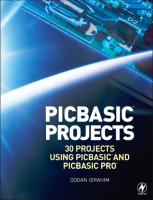
PICBasic Projects - 30 Projects using PICBASIC and PIC BASIC PRO; Dogan Ibrahim (Newnes, 2006).pdf


Product Description


By Dogan Ibrahim
Covering the PICBASIC and PICBASIC PRO compilers, PICBASIC Projects provides an easy-to-use toolkit for developing applications with PICBASIC. Numerous simple projects give clear and concrete examples of how PICBASIC can be used to develop electronics applications, while larger and more advanced projects describe program operation in detail and give useful insights into developing more involved microcontroller applications.
  • Packed with simple and advanced projects which show how to program a variety of interesting electronic applications using PICBASIC and PICBASIC PRO
  • Covers the new and powerful PIC16F627 and PIC16F73, and the popular PIC16F84 and PIC16F877 models.
  • A CDROM includes program source files, HEX code, data sheets of devices, sensors and schematics of the circuits used in the book
Contents: Chapter 1: Microcontroller Systems
Chapter 2: The PIC Microcontroller
Chapter 3: Using BASIC Language to Program PIC Microcontrollers
Chapter 4: PIC BASIC Project Development
Chapter 5: Light Projects
Chapter 6: Sound Projects
Chapter 7: Temperature Projects
Chapter 8: RS232 Serial Communications Projects
Appendix A: ASCII Code
Appendix B: PICBASIC Instruction Set
Appendix C: PICBASIC PRO Instruction Set


Download


Design With Pic Microcontrollers ,Embedded Design with the PIC18F452 by John B Peatman - 5 Star Review.pdf


Product Description

Appropriate for upper-level undergraduate courses on Microcontrollers in Electrical or Computer Engineering.Focuses on the use of Microchip Technology's "PIC" microcontroller chips to integrate the features of a digital design. The book introduces program writing with a series of code templates that helps readers learn by doing rather that start their own code writing from scratch.
 From the Back Cover
FEATURES:

* Uses detailed block diagrams to illustrate all registers, control bits, and status bits associated with assorted functions.
* Uses examples throughout to illustrate points and to show readers how assorted issues can be handled.
* Provides a systematic path into the PIC microcontrollers by showing its organization and ways to deal with its complexities.
* Provides alternative methods for addressing interrupt timing constraints designed to meet the needs of all interrupt sources.
* Presents a systematic treatment of slowly changing events, including keyswitches that have been debounced and scanned with a state machine implementation.
* Includes the I/O port expansion using the serial peripheral interface that provides a simple mechanism for eliminating the problem of "not enough pins."
* Presents expansion with I2C devices.
* Presents the details of the PIC's unusually flexible analog-to- digital conversion facility.
* Discusses the master-slave interconnection of PICs.
* Presents low-power operation alternatives.
* Provides quick insight into the family member which will meet design requirements with block diagram comparisons of PIC family members.(Figure A-4)
* Includes several important pedagogical features:

* Problems at the end of each chapter reinforce the material presented.

Download


Programming PIC Microcontrollers with PICBASIC (Embedded Technology).pdf


Book Description

Offers a complete introduction to programming the world's most commonly used microcontroller, the Microchip PIC, with the powerful but easy to use PICBASIC language.

Product Description

This comprehensive tutorial assumes no prior experience with PICBASIC. It opens with an introduction to such basic concepts as variables, statements, operators, and structures. This is followed by discussion of the two most commonly used PICBASIC compilers. The author then discusses programming the most common version of the PIC microcontroller, the 15F84.
The remainder of the book examines several real-world examples of programming PICs with PICBASIC. In keeping with the integrated nature of embedded technology, both hardware and software are discussed in these examples; circuit details are given so that readers may replicate the designs for themselves or use them as the starting points for their development efforts.
*Offers a complete introduction to programming the world's most commonly used microcontroller, the Microchip PIC, with the powerful but easy to use PICBASIC language
*Gives numerous design examples and projects to illustrate important concepts
*Accompanying CD contains the source files and executables discussed in the book as well as an electronic version of the book

From the Back Cover

*Gives numerous design examples and projects to illustrate important concepts
*This comprehensive tutorial assumes no prior experience with PICBASIC
*Accompanying CD contains the source files and executables discussed in the book as well as an electronic version of the book

The PICBASIC programming language makes it possible to create powerful software for the PIC microcontroller in days instead of the weeks required when using assembly language. This comprehensive tutorial assumes no prior experience with PICBASIC. It opens with an introduction to such basic concepts as variables, statements, operators, and structures. This is followed by discussion of the two most commonly used PICBASIC compilers. The author then discusses programming the most common version of the PIC microcontroller, the 15F84. The remainder of the book examines several real-world examples of programming PICs with PICBASIC. In keeping with the integrated nature of embedded technology, both hardware and software are discussed in these examples; circuit details are given so that readers may replicate the designs for themselves or use them as the starting points for their development efforts.

About the Author

Founder and president of elproducts, Inc., a firm specializing in devices and project kits based on the PIC microcontroller. He writes a monthly column on the PIC microcontroller for "Nuts and Volts" magazine.

Download


PIC Microcontrollers - Know it all, 2008, Bates, Jasio, Hellebuyck, Ibrahim, Morton, Smith & Wilmshurst.pdf


Product Description

The Newnes Know It All Series takes the best of what our authors have written over the past few years and creates a one-stop reference for engineers involved in markets from communications to embedded systems and everywhere in between.

PIC design and development a natural fit for this reference series as it is one of the most popular microcontrollers in the world and we have several superbly authored books on the subject.
This material ranges from the basics to more advanced topics. There is also a very strong project basis to this learning. The average embedded engineer working with this microcontroller will be able to have any question answered by this compilation. He/she will also be able to work through real-life problems via the projects contained in the book. The Newnes Know It All Series presentation of theory, hard fact, and project-based direction will be a continual aid in helping the engineer to innovate in the workplace.
Section I. An Introduction to PIC Microcontrollers
Chapter 1. The PIC Microcontroller Family
Chapter 2. Introducing the PIC 16 Series and the 16F84A
Chapter 3. Parallel Ports, Power Supply and the Clock Oscillator

Section II. Programming PIC Microcontrollers using Assembly Language
Chapter 4. Starting to Program-An Introduction to Assembler
Chapter 5. Building Assembler Programs
Chapter 6. Further Programming Techniques
Chapter 7. Prototype Hardware
Chapter 8. More PIC Applications and Devices
Chapter 9. The PIC 1250x Series (8-pin PIC microcontrollers)
Chapter 10. Intermediate Operations using the PIC 12F675
Chapter 11. Using Inputs
Chapter 12. Keypad Scanning
Chapter 13. Program Examples

Section III. Programming PIC Microcontrollers using PicBasic
Chapter 14. PicBasic and PicBasic Pro Programming
Chapter 15. Simple PIC Projects
Chapter 16. Moving On with the 16F876
Chapter 17. Communication

Section IV. Programming PIC Microcontrollers using MBasic
Chapter 18. MBasic Compiler and Development Boards
Chapter 19. The Basics-Output
Chapter 20. The Basics-Digital Input
Chapter 21. Introductory Stepper Motors
Chapter 22. Digital Temperature Sensors and Real-Time Clocks
Chapter 23. Infrared Remote Controls

Section V. Programming PIC Microcontrollers using C
Chapter 24. Getting Started
Chapter 25. Programming Loops
Chapter 26. More Loops
Chapter 27. NUMB3RS
Chapter 28. Interrupts
Chapter 29. Taking a Look under the Hood

*Over 900 pages of practical, hands-on content in one book!
*Huge market - as of November 2006 Microchip Technology Inc., a leading provider of microcontroller and analog semiconductors, produced its 5 BILLIONth PIC microcontroller
*Several points of view, giving the reader a complete 360 of this microcontroller

About the Author

Lucio Di Jasio is now Sales Manager in Europe for Microchip Inc. He was previously Application Segments Manager at Microchip in Chandler AZ. He has been intimately involved in the development of Microchip PIC products for over 10 years and is a well known writer and expert on the use of PIC products both via his Newnes books and his work at events such as the Microchip Masters.Tim Wilmshurst is the author of Designing Embedded Systems with PIC Microcontrollers. He has been designing embedded systems since the early days of microcontrollers. For many years this was for Cambridge University, where he led a development team building original systems for research applications - for example in measurement of bullet speed, wind tunnel control, simulated earthquakes, or seeking a cure to snoring. Now he is Head of Electronic Systems at the University of Derby, where he aims to share his love of engineering design with his students.
Dogan Ibrahim works for the Traffic Control Systems Unit in London, UK. He was formerly a lecturer at South Bank University and Head of Department at Near East University, Cyprus in the UK.
Founder and president of elproducts, Inc., a firm specializing in devices and project kits based on the PIC microcontroller. He writes a monthly column on the PIC microcontroller for "Nuts and Volts" magazine.

Download


Sunday, May 9, 2010

PIC in Practice, Second Edition: A Project -based Approach


Review

'It will make practical PIC applications available to a wider, less specialised audience.. Very thoughtful, careful use of language... Excellent selection of examples in terms of range and complexity... Given the rapidly expanding application of PICs, partiularly in education, there will be a need for books like this.' Paul Wareing,
University of Wolverhampton. -- Review --This text refers to an out of print or unavailable edition of this title.

Review

'It will make practical PIC applications available to a wider, less specialised audience.. Very thoughtful, careful use of language... Excellent selection of examples in terms of range and complexity... Given the rapidly expanding application of PICs, partiularly in education, there will be a need for books like this.' Paul Wareing, University of Wolverhampton. --This text refers to an out of print or unavailable edition of this title.

Download


PIC Robotics: A Beginner's Guide to Robotics Projects Using the PIC Micro


Product Description

Here's everything the robotics hobbyist needs to harness the power of the PICMicro MCU! In this heavily-illustrated resource, author John Iovine provides plans and complete parts lists for 11 easy-to-build robots each with a PICMicro "brain. The expertly written coverage of the PIC Basic Computer makes programming a snap -- and lots of fun.

From the Back Cover

Complete, do-it-yourself robotics projects! SMART 'BOTS!

* Artificial vision system that uses a CCD camera to track and follow brightly colored objects
* Bi-pedal robots that walk upright
* Functional robotic arm
* Easily programmed behavior-based robots
* Complete parts lists for all projects
* Step-by-step directions for several complete projects -- inspiration for hundreds more
PUT POWERFUL, LOW-COST MICROCHIPS AND NEW TECHNOLOGIES INTO HOME-BUILT ROBOTS
Dramatic improvements in technologies and significant cost reductions in 8-bit microprocessors have spawned a renaissance in robot building. PIC Robotics, from popular electronics author John Iovine, shows amateur (and professional) electronics enthusiasts how to get in on the fun, using the power of Microchip's versatile 8-bit PIC microprocessor family to build sophisticated robots more cheaply and easily than you thought possible.
With PIC Robotics, you can build robots that:
* Use a CCD camera to capture and follow a visual target
* Walk on two legs (bi-pedal walker)
* Walk on six legs (hexapodal walker)
* Obey verbal commands (speech recognition)
* Look for and track bright light sources
* And do it inexpensively

Download


PIC Microcontroller Project Book : For PIC Basic and PIC Basic Pro Compliers


The PIC microcontroller is enormously popular both in the U.S. and abroad. The first edition of this book was a tremendous success because of that. However, in the 4 years that have passed since the book was first published, the electronics hobbyist market has become more sophisticated.


Many users of the PIC are now comfortable shelling out the $250 for the price of the Professional version of the PIC BasicThis new edition is fully updated and revised to include detailed directions on using both versions of the microcontroller, with no-nonsense recommendations on which is better served in different situations.
Download


Programming and Customizing the PIC Microcontroller


Product Description

MASTER PIC MICROCONTROLLER TECHNOLOGY AND ADD POWER TO YOUR NEXT PROJECT!
Tap into the latest advancements in PIC technology with the fully revamped Third Edition of McGraw-Hill's Programming and Customizing the PIC Microcontroller. Long known as the subject's definitive text, this indispensable volume comes packed with more than 600 illustrations, and provides comprehensive, easy-to-understand coverage of the PIC microcontroller's hardware and software schemes.


With 100 experiments, projects, and libraries, you get a firm grasp of PICs, how they work, and the ins-and-outs of their most dynamic applications. Written by renowned technology guru Myke Predko, this updated edition features a streamlined, more accessible format, and delivers:
  • Concentration on the three major PIC families, to help you fully understand the synergy between the Assembly, BASIC, and C programming languages
  • Coverage of the latest program development tools
  • A refresher in electronics and programming, as well as reference material, to minimize the searching you will have to do
WHAT'S INSIDE!
  • Setting up your own PIC microcontroller development lab
  • PIC MCU basics
  • PIC microcontroller interfacing capabilities, software development, and applications
  • Useful tables and data
  • Basic electronics
  • Digital electronics
  • BASIC reference
  • C reference
  • 16-bit numbers
  • Useful circuits and routines that will help you get your applications up and running quickly

From the Back Cover

For complete, practical insight into the chip that is quickly becoming the microcontroller of choice throughout the world. The use of Microchip's PIC family of microcontrollers is growing rapidly worldwide. This tutorial/disk package is unique in providing you with a complete understanding of the PIC chip and all the information needed to design and debut tailor-made applications using the PIC family of devices. Programming and Customizing the PIC Microcontroller details the features of the PIC microcontroller and how different devices are accessed and controlled. It shows what happens within the PIC when an instruction is executed and how PICs can be interfaced with external devices. The heart of the book includes: 12 complete projects which illustrate the PIC's capabilities; over 30 experiments to reinforce your grasp of how the PIC works; a discussion of how the devices are electronically programmed; an explanation of the tools used for developing code for PIC applications; suggestions for debugging and easier code development. A diskette augments the book by offering all the Microchip software tools needed to program the PIC, sample application programs, and reusable code. Extensive appendixes include additional resources that can help you in developing and debugging PIC applications as well as tips on how to avoid typical application problems. --This text refers to an out of print or unavailable edition of this title. 


Download


Designing Embedded Systems With PIC Microcontrollers: Principles and Applications (Broché)


Book Description

This book is a hands-on introduction to the principles and
practice of embedded system design using the PIC microcontroller. Packed
with helpful examples and illustrations, it gives an in-depth treatment of
microcontroller design, programming in both assembly language and C, and
features advanced topics such as networking and real-time operating


systems. It is accompanied by a CD-ROM containing copies of all programs
and software tools used in the text and a `student' version of the C
complier Designing Embedded Systems with PIC Microcontrollers: Principles and
Applications is ideal for students of electronics, mechatronics and
computer engineering. Engineers in industry and informed hobbyists will
also find this book a valuable resource when designing and implementing
both simple and sophisticated embedded systems using the PIC
Microcontroller.


Download


Programming 32-bit Microcontrollers in C: Exploring the PIC32 (Embedded Technology)


Book Description

The FIRST book on Microchip's latest and greatest 32-bit architecture: the PIC32 written by a true Microchip insider!

Product Description

*Just months after the introduction of the new generation of 32-bit PIC microcontrollers, a Microchip insider and acclaimed author takes you by hand at the exploration of the PIC32


*Free CD-ROM includes source code in C and the Microchip MPLAB C32 compiler

*Includes handy checklists to help readers perform the most common programming and debugging tasks

The new 32-bit microcontrollers bring the promise of more speed and more performance while offering an unprecedented level of compatibility with existing 8 and 16-bit PIC microcontrollers. In sixteen engaging chapters, using a parallel track to his previous title dedicated to 16-bit programming, the author puts all these claims to test while offering a gradual introduction to the development and debugging of embedded control applications in C.
Author Lucio Di Jasio, a PIC and embedded control expert, offers unique insight into the new 32-bit architecture while developing a number of projects of growing complexity.
Experienced PIC users and newcomers to the field alike will benefit from the text's many thorough examples which demonstrate how to nimbly side-step common obstacles, solve real-world design problems efficiently and optimize code using the new PIC32 features and peripheral set.

You will learn about:
*basic timing and I/O operation
*debugging methods with the MPLAB SIM *simulator and ICD tools
*multitasking using the PIC32 interrupts
*all the new hardware peripherals
*how to control LCD displays
*experimenting with the Explorer16 board and *the PIC32 Starter Kit
*accessing mass-storage media
*generating audio and video signals
*and more!

TABLE OF CONTENTS
Day 1 And the adventure begins
Day 2 Walking in circles
Day 3 Message in a Bottle
Day 4 NUMB3RS
Day 5 Interrupts
Day 6 Memory
Part 2 Experimenting
Day 7 Running
Day 8 Communication
Day 9 Links
Day 10 Glass = Bliss
Day 11 It's an analog world
Part 3 Expansion
Day 12 Capturing User Inputs
Day 13 UTube
Day 14 Mass Storage
Day 15 File I/O
Day 16 Musica Maestro!

*32-bit microcontrollers are becoming the technology of choice for high performance embedded control applications including portable media players, cell phones, and GPS receivers.
*Learn to use the C programming language for advanced embedded control designs and/or learn to migrate your applications from previous 8 and 16-bit architectures.
*All code examples and software tools required to get acquainted with Microchip's MPLAB development environment, and to complete all the projects described in the book, are offered in the attached CDROM including the MPLAB C32 C Compiler (free Student Edition) and the full source code for more than 15 entertaining projects.

Download


Pic Microcontroller: An Introduction to Software and Hardware Interfacing


Book Description

This book presents a thorough introduction to the Microchip PIC® microcontroller family, including all of the PIC programming and interfacing for all the peripheral functions. A step-by-step approach to PIC assembly language programming is presented, with tutorials that demonstrate how to use such inherent development tools such as the Integrated Development Environment MPLAB, PIC18 C compiler, the ICD2 in-circuit debugger, and several demo boards. 
Comprehensive coverage spans the topics of interrupts, timer functions, parallel I/O ports, various serial communications such as USART, SPI, I2C, CAN, A/D converters, and external memory expansion.

About the author

Han-Way Huang is a Professor in the Department of Electrical and Computer Engineering and Technology at Minnesota State University, Mankato, MN. He is a member of both IEEE and ASEE. Dr. Huang has taught microprocessor applications for more than 15 years and has authored several books on microprocessors.

Download


The PIC Microcontroller: Your Personal Introductory Course, Third Edition


Book Description

A uniquely concise and practical guide to getting up and running with the PIC Microcontroller.

Product Description

John Morton offers a uniquely concise and practical guide to getting up and running with the PIC Microcontroller. The PIC is one of the most popular of the microcontrollers that are transforming electronic project work and product design, and this book is the ideal introduction for students, teachers, technicians and electronics enthusiasts.

Assuming no prior knowledge of microcontrollers and introducing the PIC Microcontroller's capabilities through simple projects, this book is ideal for electronics hobbyists, students, school pupils and technicians. The step-by-step explanations and the useful projects make it ideal for student and pupil self-study: this is not just a reference book - you start work with the PIC microcontroller straight away.
The revised third edition focuses entirely on the re-programmable flash PIC microcontrollers such as the PIC16F54, PIC16F84 and the extraordinary 8-pin PIC12F508 and PIC12F675 devices.

* Demystifies the leading microcontroller for students, engineers an hobbyists
* Emphasis on putting the PIC to work, not theoretical microelectronics
* Simple programs and circuits introduce key features and commands through project work

 Download


Embedded C Programming and the Microchip Pic (Broché)


Book Description

This new book is carefully designed to teach C language programming as it applies to embedded microcontrollers and to fuel knowledge in the application of the Microchip® family of PIC® microcontrollers. Coverage begins with a step-by-step exploration of the C language showing readers how to create C language programs to solve problems. PIC processors are then studied, from basic architecture to all of the standard peripheral devices included in the microcontrollers. Numerous worked-out example programs demonstrate common uses for each of the peripherals. Readers are subsequently introduced to the built-in functions available in C, to help speed their programming and problem solving. 
Finally, readers are taken through use of the C Compiler, and learn to efficiently develop custom projects.

JA Majors Book Info

Text teaches C language programming and explores PIC microcontroller applications. Shows readers how to create programs and solve problems. Softcover.

About the author

Professor of Electrical Engineering Technology Purdue University Dr. Barnett has been instructing in the area of embedded microcontrollers for the past eighteen years, starting with the Intel 8085, progressing to several members of the 8051 family of embedded microcontrollers, and now teaching Advanced Embedded Microcontrollers using the Atmel AVR devices. During his summers and two sabbatical periods, he worked extensively with multiple-processor embedded systems, applying them in a variety of control-oriented applications. In addition, he consults actively in the field. Prior to his tenure at Purdue University, he spent ten years as an engineer in the aerospace electronics industry. In terms of teaching, Dr. Barnett has won a number of teaching awards, including the Charles B. Murphy Award as one of the best teachers at Purdue University. He is also listed on Purdue University’s Book of Great Teachers, a list of the 225 most influential teachers over Purdue’s entire history. This is his third text.

 Download


Advanced PIC Microcontroller Projects in C: From USB to RTOS with the PIC 18F Series

This book is ideal for the engineer, technician, hobbyist and student who have knowledge of the basic principles of PIC microcontrollers and want to develop more advanced applications using the 18F series.
The architecture of the PIC 18FXXX series as well as typical oscillator, reset, memory, and input-output circuits is completely detailed. After giving an introduction to programming in C, the book describes the project development cycle in full, giving details of the process of editing, compilation, error handling, programming and the use of specific development tools.

           The bulk of the book gives full details of tried and tested hands-on projects, such as the 12C BUS, USB BUS, CAN BUS, SPI BUS and real-time operating systems.
* A clear introduction to the PIC 18FXXX microcontroller’s architecture
* 20 projects, including developing wireless and sensor network applications, using I2C BUS, USB BUS, CAN BUS and the SPI BUS, which give the block and circuit diagram, program description in PDL, program listing and program description.
* Numerous examples of using developmental tools: simulators, in-circuit debuggers (especially ICD2) and emulators
* A CDROM of all the programs, hex listings, diagrams, data sheets and tables

Download


Copyright Disclaimer:

This site does not store any copyright contents on its server. If any, email us, we'll remove relevant links or contents immediately. email: smsumesh89@gmail.com
Twitter Delicious Facebook Digg Favorites More